Sunday, 21 December 2014

41) Orange is the New Black 42) The Member of the Wedding

41) Orange is the New Black by Piper Kerman

Having really enjoyed the Netflix adaptation of this book, I must say I was disappointed with it, although that may partly be because I was always biased towards the series. Firstly, the character names are different, which I found disconcerting, there also wasn't any insight into the other character's pre-prison lives, which is one of the things that I really enjoy about the series. Additionally I found that some of the writing was a bit too obvious, especially the introduction. However, moving on to things I did like; I finally understood why Boo has a dog in prison (she's training it to be used as a seeing-eye dog in a scheme called "Puppies Behind Bars"). The book also made me think more deeply about the federal system; prison isn't necessarily the best option for non-violent crimes, as it doesn't help with rehabilitation, and so inmates become institutionalised and often end up back in prison after they are released. I found the following sentence very poignant: "The  lesson that our prison system teaches its residents is how to survive as a prisoner, not as a citizen - not a very constructive body of knowledge for us or the communities to which we return."


42) The Member of the Wedding by Carson McCullers

Another novel for "The Girl in the Book" module, it's again one I probably wouldn't have read otherwise, but I'm really glad that I did. I have to admit that I was not at all convinced at the beginning, as I found the modernist style a bit off-putting (I kid you not, the word "lavender" is used eight times!) but I got used to it and even began to enjoy it eventually. It's painful how naive Frankie is, and the scene with the soldier had me really frightened for her for a while. I find it interesting how the book can be divided into three sections by what she chooses to call herself: when she is Frankie she is looking to belong, when she is F. Jasmine she thinks she has found her rightful place, and when she is Frances she realises that she was wrong.  This book is all about not belonging; Berenice, her African American maid, doesn't have an equal place in society because of her colour, John Henry, her cousin, wants to be "half boy and half girl", and Frankie herself wishes that people could "change back and forth from boys to girls". It's about being trapped by society's expectations on race and gender, and on love. It's about realising that these invisible boundaries exist, and that discovering that is part of growing up. Frankie sums this up nicely: "In a way she was sorry. It was better to be in a jail where you could bang the walls than in a jail you could not see."


Both of these books deal with imprisonment in different ways. We are both trapped by ourselves and our own actions and by those around us. They are both about learning to cope with different prisons, though Piper gets out of hers, while Frankie only discovers hers at the end of the book.     

Saturday, 20 December 2014

39) A Room of One's Own 40) Frost in May

39) A Room of One's Own by Virginia Woolf

I had to read this for The Girl in the Book, and  while finding the ideas about women's independence interesting, I found it a bit hard to get through, especially since it's an extended essay rather than a novel, and I find it hard to engage with non-fiction. I definitely wouldn't have finished it if I hadn't been studying it, but I'm glad that I did have to read it, as it's a very influential piece of writing, and (to my slight shame) it's the first time I've read anything by Virginia Woolf. I really want to go on to read her novel Orlando, of which I have already seen the film adaptation, as I think that it has some interesting things to say about the fluidity of gender.


40) Frost in May by Antonia White

I will be studying this book for the aforementioned module in January, and I will be interested to see what my lecturer has to say about it, as I found it to be very engaging and enjoyable to read. Having previously read a couple of novels about life in monasteries (The Hawk and the Dove and Sucking Sherbet Lemons), I believe this to be my first novel about life in a convent (I'm not counting Madeline :p), and I find it intriguing in its exploration of the rigidity of convent school life. This very rigidity (the girls are not even allowed to bathe naked) lends itself to small acts of rebellion which bubbles beneath the strict timetable and rules. Nanda has "particular friendships" with other girls despite the fact that it is forbidden, and these friendships seem to hover on the edge between platonic and romantic, as the girls' need for love is met in each other. The shocking denouement of the novel is actually disappointingly under-dramatised and abrupt, leaving us rather dissatisfied, however there are three "sequels" (I put "sequels" in quotation marks, as White changed the name of the main character from Nanda to Clara) to Frost in May, and it would be interesting to see where life outside the convent would take Nanda/ Clara.

Friday, 19 December 2014

37) An Abundance of Katherines 38) The Well of Loneliness


37) An Abundance of Katherines by John Green

Already a fan of The Fault in Our Stars, I had been pre-warned that the rest of John Green's books weren't as good, and I have to agree. I'm sure sure whether it's the subject matter; a book about a girl with cancer lends itself better to being emotionally profound than a book about a guy who's dated a whole series of girls with the same names, but I definitely connected with this book a lot less than TFIOS. You could also argue that that's due to there being a male protagonist rather than a female one, but having a male protagonist didn't stop me from connecting with Christopher in Haddon's The Curious Incident of The Dog in the Night-time, who in fact shares a lot of traits with Colin, the protagonist of this book, so I strongly suspect of having Asperger's Syndrome. While I lacked a personal connection with the story, I did enjoy it a lot, and found both Colin and Hassan amusing and interesting characters, although I was less convinced by Lindsey. I enjoyed the way in which the plot slowly revealed Colin's back story with all the different Katherines, which developed along with his "theorem" for predicting relationships, but that doesn't stop me from finding it highly unrealistic that 1) Colin would have had so many girlfriends (especially given his dedication to improving his mind, which seems to leave little time for other things) and 2) that they would have all been called Katherine. Overall I recommend this book if you enjoyed The Fault in Our Stars, but don't expect it to stay with you in the same way.


38) The Well of Loneliness by Radclyffe Hall

This is another book on my course "the Girl in the Book". For a book written in the 1920s, I was surprised at how candid this novel was about lesbianism, or "inversion" as it was then called, though I think that rather than being a lesbian novel, it could nowadays been seen as a transgender one, as Stephen repeatedly wishes to be a man (and yes, her parents chose to call her Stephen, even though she was a girl, don't ask me why) when she's younger, and aspires to look like one when she is older. I think that if given the option to transition then she probably would have. Even though there's nothing more explicit than"and that night, they were not divided" in the novel, it was judged obscene by a British court and the publisher was forced to have it printed France and secretly shipped over to England. Just as Stephen was censored by her family and the society in which she lived, Hall was censored for daring to broach such a controversial subject. This makes me realise how lucky we are these days (in the UK at least) to live in a society where there is freedom of speech and people can access all the information they want at the touch of a button.

Thursday, 18 December 2014

35) La Symphonie Pastorale 36) My Ántonia


35) La Symphonie Pastorale by André Gide

Another book from my course on blindness and vision, this presents a very different perspective on blindness than Husson's Reflections. Most notably,  it is told from the pastor's point of view, so we do not get direct insight into Gertrude's mind as we do with Husson, instead we "see" blindness through the pastor's eyes, as he models Gertrude into his "blind ideal".  As with all texts exploring blindness, there are ethical implications to the fact that Gide (himself sighted) has chosen to use it in his plot. I cannot help thinking that much as the pastor manipulates Gertrude, Gide manipulates blindness in order to further his narrative. However, interestingly, the operation that restores Gertrude's sight is ultimately presented as something negative that should not have been taken for granted as having a positive effect on Gertude's life, thus undermining our preconceived notions about blindness and vision: blindness is not necessarily a bad thing, and those with fully functioning eyes  can be just as "blind" (I've put this in speech-marks as using blindness as a negative metaphor is not constructive) as those who cannot see. Indeed, this text presents a theme that has resonated to a greater or lesser extent with all of the texts that we've studied so far: it is not blind people that need to be cured, but society. 


36) My Ántonia by  Willa Cather

This is an intriguing novel  about growing up. Though it is part of my "The Girl in the Book" course, it is told through Jim Burden's eyes, and so we get very little interiority from Ántonia, or "Tony". Their relationship is quite ambiguous: Jim shows little interest in pursuing a romantic relationship with Ántonia  while growing up, and yet tells her children at the end that he loved her. This ambivalence could be interpreted as a representation of Cather's own feelings; now publicly acknowledged as a lesbian, some critics see Jim as representing Cather in the novel, and thus his strange relationship with Ántonia is a product of Cather's fear of stigmitisation. Whether or not this is the case, it is not something that I picked up on myself when reading the novel; I was more interested in the lacunae of the text, which led me to believe that Jim is an unreliable narrator, as he seems to omit some things, even to himself.     

Wednesday, 17 December 2014

33) Measure for Measure 34) Reflections: The Life and Writings of a Young Blind Woman in Post-Revolutionary France

I'm still catching up on my back-log, so expect multiple posts in the next few days :)


33 ) Measure for Measure by William Shakespeare

Out of the three problem plays that I've studied this year, Measure for Measure is my favourite. To have such a strictly moral man turn to the very vice that he condemns makes for a very interesting plot, and the disguised duke creates a pleasing, and sometimes amusing, dramatic irony. None of the characters are completely black or white; even Isabella, the most innocent of all, lies in order to achieve her ends. This play, like All's Well that Ends Well, presents is ethically problematic, as the bed-trick, which lacks informed consent, and would nowadays be considered as rape, is presented as a neat solution in order to make Angelo do his duty. While I definitely think that Angelo should be made to fulfill his betrothal, I don't agree with the way that Isabella and Mariana go about it, and yet I can see no other solution that would bind him to the latter and save the brother of the former. I can see why it's classed as a "problem play"...

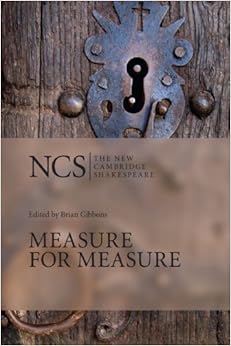
On a side note, I think that the cover of the copy I have (see picture) is very clever, as it combines the sexual imagery of a keyhole (representing Isabella) and the Christian symbol of the cross (representing Angelo), and shows the problematic disparity that defines the play.


34) Reflections: The Life and Writings of a Young Blind Woman in Post-Revolutionary France by Thérèse- Adèle Husson 

This is another book I've been studying, this time for the module Blindness and Vision in French Culture (the first book we studied for that course, L'aveugle by Maupassant, was a really short story, so I didn't feel I could justify counting it as one of my 500 books). I have to admit that I was a bit pressed for time when I read it originally, and so read it in English (which language students definitely don't do...ever... ^^) However, I have since gone back and read it in French, so I don't feel quite so naughty.
This book gives us a really interesting, and unprecedented, perspective into the mind of a young blind woman in 1825. She writes on subjects such as clothing, animals, people and education, and how all of these are experienced by blind people. while seeming very pious, we do have to bear in mind that Husson wrote her Reflections with the aim of gaining a place at the prestigious Quinze-Vingts Hospital (a hospital for blind people founded in 1260 by Louis XI), and would therefore have been tailoring her writing to please the director. She also directly contravened her views expressed on the marrying of blind people, as she went on o marry a blind man herself, and have children with him. She may have pretended to be against it for the sake of gaining a place at the hospital (which strongly discouraged blind people from marrying), or she may have just changed her mind when she went to Paris and met her future-husband, we will sadly never know.
Overall a really interesting perspective on blindness and the role of both blind people and their friends and family; this text raises some intriguing questions on the appropriateness of the social model of disability, and our ocularcentric view of the world. 


Sunday, 30 November 2014

31) Kind of Cruel 32) All's Well That Ends Well

31) Kind of Cruel by Sophie Hannah

The alternating points of view in this thriller come slowly together, revealing the importance of Little Orchard and why four members of her family disappeared one Christmas, only to come back two days later without a word.  Kind, Cruel, Kind of Cruel; the phrase reverberates through the novel, but what does it mean, and why is Amber arrested for saying it? This book is well-crafted and enjoyable to read, if not exactly relaxing. One to take on holiday, rather than late-night literature.


32) All's Well That Ends Well by William Shakespeare

I'd never seen/ read this play before studying it this year, and while not one of my favourite Shakespeare plays, I enjoy the interesting gender dynamics implicated by Helen and Bertram's marriage and the bed trick. It's made me question my ideas on the ethics of deceit  and reconsider class distinctions.Undermining our expectations in many ways, it's easy to see why this is classed as a problem play; even the supposedly happy ending leaves us unsatisfied, as we question Bertram's conditional terms, and his ability to fulfill them. All's well that ends well, the title tells us, but in agreeing with this we are implicated in the characters' deceit and betrayal; can the end really justify the means?